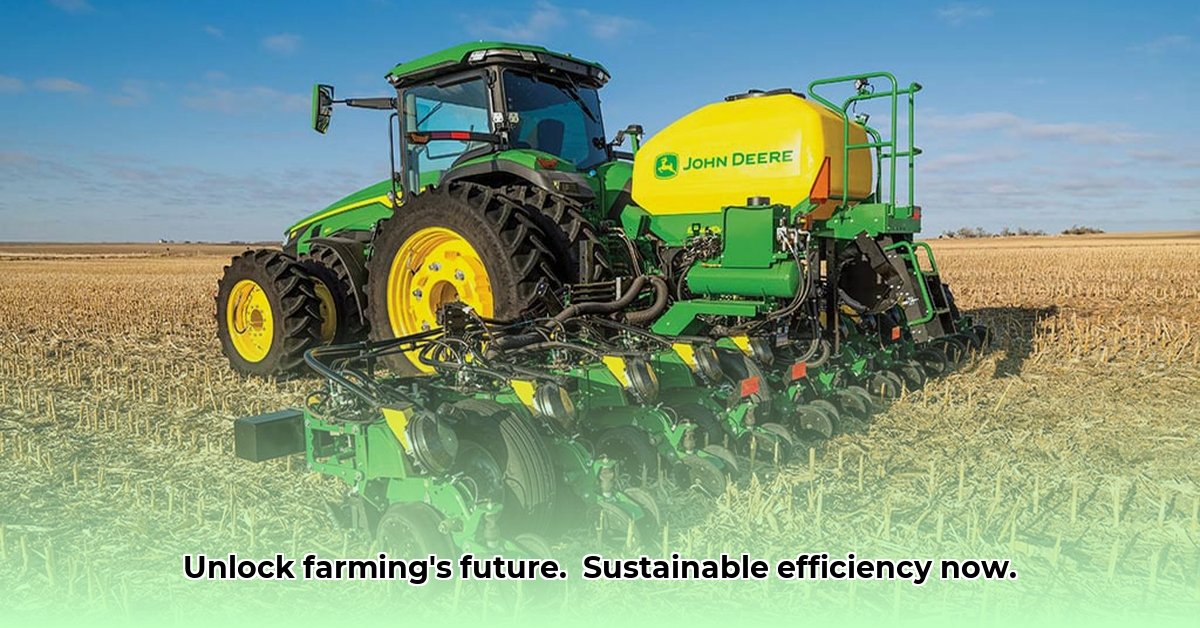
Planter Tractor: Revolutionizing Sustainable Farming
Planter tractors are transforming modern agriculture, offering a path towards more efficient and environmentally friendly farming practices. These advanced machines enable incredibly accurate seed placement, maximizing yields while minimizing waste and resource consumption. They represent a significant advancement over traditional methods, ushering in an era of precision agriculture.
Planting with Surgical Precision: The Power of Precision Planting
Imagine planting each seed with pinpoint accuracy – at the optimal depth and spacing, with the precise amount of fertilizer. Precision planting, facilitated by modern planter tractors, makes this a reality. This level of control translates to fewer wasted seeds, reduced fertilizer runoff, and a healthier environment. Higher crop yields per acre directly lead to increased profitability and a smaller environmental footprint. Isn't it remarkable how technology can enhance both economic returns and environmental stewardship?
GPS Guidance: Your Field's Virtual GPS
GPS-guided planter tractors use satellite technology to ensure perfectly straight planting rows, eliminating overlaps and gaps. This guarantees that every square inch of your field is utilized efficiently, maximizing resource use. Think of it as having a highly accurate digital ruler guiding the planting process across expansive fields. Consistent planting depth also optimizes seed-to-soil contact, boosting germination rates and fostering stronger, healthier plants. This results in more predictable crop yields and reduced uncertainty. How much time and resources do you think this saves farmers annually? Recent studies show significant improvements in operational efficiency.
Variable Rate Technology (VRT): Customizing Care for Every Inch
Variable Rate Technology (VRT) takes precision planting to another level. Sensors analyze soil conditions in real-time, enabling the tractor to adjust fertilizer, pesticide, and seed application rates precisely where needed. This targeted approach minimizes waste, reduces environmental risks associated with over-application, and optimizes resource allocation. It's akin to providing customized care to each part of the field. Wouldn't this also help reduce the cost of inputs, resulting in greater profitability? The data indicates significant cost savings for those adopting VRT.
Sustainability: Farming for the Future
Precision planting is integral to sustainable agriculture. The reduced need for fertilizers and pesticides preserves soil health and water quality. Minimized soil disturbance, often associated with no-till farming practices, enhances biodiversity further. These combined effects contribute to a healthier environment and a more resilient food system. What are the long-term economic and environmental benefits of such sustainable practices? Experts forecast significant positive impacts across the agricultural sector.
The Challenges and Opportunities: Making it Happen
Despite the clear advantages, challenges remain. The high initial investment cost can be prohibitive for smaller farms. Furthermore, effective operation demands specific training and reliable internet access. However, leasing options, collaborative purchasing schemes, and expanded training programs are addressing these barriers. The potential return on investment, however, often outweighs the initial costs.
Taking Action: A Step-by-Step Guide for Farmers
- Needs Assessment: Evaluate farm size, crops, current practices, and financial resources.
- Financial Planning: Explore financing options, including leasing and grants.
- Technology Selection: Choose a planter system suited to specific crop and soil conditions.
- Training and Support: Invest in thorough training for optimal system operation and maintenance.
- Data Management: Utilize data analytics to refine planting strategies for continual improvement.
The Future is Bright: The Next Generation of Planter Tractors
The future of planter tractors points towards even greater levels of precision, efficiency, and sustainability. AI and automation are poised to revolutionize the industry, leading to self-adjusting systems that respond to changing conditions in real-time. These advancements promise a more resilient and productive agricultural sector.
Managing the Risks: Protecting Your Investment
Implementing new technologies always involves risk. Here's a summary of potential challenges and mitigation strategies:
| Feature | Probability of Failure | Impact of Failure | Mitigation Strategy |
|---|---|---|---|
| GPS System | Medium | Medium | Redundant GPS, regular calibration, operator training |
| VRT | Low | Medium | Sensor calibration, data validation, backup systems |
| Hydraulic System | Medium | High | Regular maintenance, preventative measures, spare parts |
| Seed Metering | Low | High | Regular maintenance, quality control |
| Data Management | Low | Medium | Secure storage, backups, regular software updates |
Proactive risk management ensures the successful integration of planter tractor technology and maximizes its benefits.
Comparing Precision Planter Technologies ROI for Small vs Large Farms
Key Takeaways:
- Precision planting significantly enhances yields and minimizes waste.
- Leading manufacturers include John Deere, Kinze, and Case IH, each offering unique advantages.
- Optimal planter selection depends on farm size, crops, and budget.
- The return on investment (ROI) varies greatly between small and large farms.
- Long-term sustainability and efficient data management are critical considerations.
"The choice of planter depends heavily on the individual farm's circumstances," states Dr. Emily Carter, Agricultural Engineering Professor at Purdue University. "Smaller operations might benefit from more adaptable, less expensive models, while large farms could justify the investment in high-speed, high-tech systems."
This highlights the need for careful consideration when selecting a precision planter system. The ability to adapt and leverage the data gathered is ultimately crucial to the success of any operation.